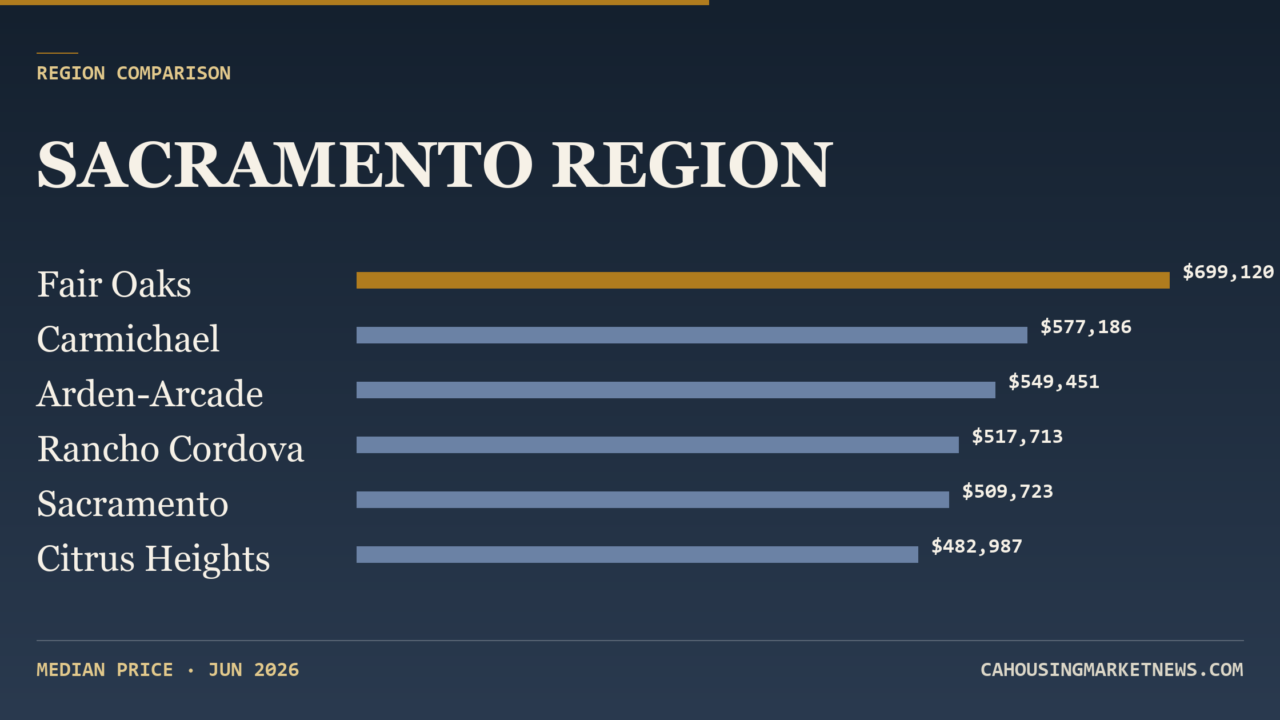
The Sacramento-area housing market split into two camps over the three months ending in June 2026, according to newly reported Redfin data. In one group, Carmichael and Arden-Arcade recorded price gains of roughly 8 percent from a year earlier. In the other, Rancho Cordova posted the region’s steepest decline, and Fair Oaks, Citrus Heights and Sacramento held roughly flat. What united all six cities was demand: home sales rose year over year in every market, ranging from a 2.1 percent gain in Sacramento to a 24.8 percent jump in Rancho Cordova.
That divergence played out against a national backdrop of slightly cheaper borrowing. The 30-year fixed mortgage rate averaged 6.49 percent in June 2026, down from 6.82 percent in June 2025 but up from 6.44 percent in May 2026, according to Freddie Mac data compiled by the Federal Reserve. Nationally, the S&P/Case-Shiller U.S. National Home Price Index was higher in its latest reading than a year earlier, indicating home prices continued to rise across the country even as several Sacramento-area cities softened.
Prices: Carmichael and Arden-Arcade lead, Rancho Cordova lags
The clearest split in the region was on price. Carmichael’s median sale price reached $577,186, up 7.8 percent from $535,500 a year earlier — the largest gain among the six cities. Arden-Arcade was close behind at $549,451, up 7.7 percent from $510,000.
At the other end, Rancho Cordova’s median sale price fell to $517,713, down 5.9 percent from $549,995 a year earlier, the region’s only decline of more than a few percentage points. Fair Oaks slipped 2.9 percent to $699,120 from $720,000, and Citrus Heights edged down 1.4 percent to $482,987 from $490,000. Sacramento, the region’s largest market, was essentially unchanged, with its median of $509,723 down 0.1 percent from $510,000.
The price ordering left Fair Oaks as the most expensive city in the group at $699,120, roughly $216,000 above Citrus Heights, the cheapest at $482,987. Sacramento, Rancho Cordova, Arden-Arcade and Carmichael filled the middle, spread across a range of about $68,000.
Sales activity: demand rose everywhere
Every city sold more homes than it did a year earlier, a consistency that stood out against the mixed price picture. Rancho Cordova recorded the sharpest increase, with 257 homes sold versus 206 a year earlier, a gain of 24.8 percent. Carmichael followed at 18.6 percent, with 217 sales compared with 183. Arden-Arcade rose 14.4 percent to 223 sales from 195.
The gains were more modest in the region’s steadier markets. Fair Oaks sales rose 8.7 percent to 113, Citrus Heights climbed 8.1 percent to 213, and Sacramento — by far the largest market at 1,125 homes sold — posted the smallest increase at 2.1 percent, up from 1,102.
Notably, Rancho Cordova and Carmichael combined the region’s largest sales gains with opposite price outcomes: Carmichael’s median rose while Rancho Cordova’s fell. In smaller markets, shifts in the mix of homes sold can move the median independently of underlying demand.
Speed and competition: Carmichael fastest, Rancho Cordova slowest
The pace of sales also separated the cities. Carmichael was the fastest market, with a median 13 days on market, unchanged from 13 days a year earlier. Fair Oaks was next at 16 days, down from 19. Sacramento (18 days, up from 17), Citrus Heights (19 days, up from 14) and Arden-Arcade (19 days, up from 10) all sat within a tight band, though Citrus Heights and Arden-Arcade saw homes take meaningfully longer to sell than they did a year ago.
Rancho Cordova was the slowest market by a wide margin, at a median 33 days on market, up from 25 a year earlier — the only city where homes routinely took more than three weeks to sell. That slower pace aligns with its price decline and its lower share of homes selling above asking.
Competition metrics reinforced the pattern. Carmichael led on both the sale-to-list ratio, at 100.7 percent, and the share of homes selling above list, at 42.5 percent. Fair Oaks, despite its price dip, also saw 42.8 percent of homes sell above list, the highest such share in the region, though its sale-to-list ratio came in slightly below asking at 99.6 percent. Rancho Cordova was the least competitive on these measures, with 30.7 percent of homes selling above list and a sale-to-list ratio of 99.7 percent. Sacramento (100.3 percent), Arden-Arcade (100.2 percent) and Citrus Heights (100.0 percent) all cleared or met their asking prices on a median basis.
Inventory: more choices in the larger markets
Sacramento carried the most active inventory by far, at 2,223 listings, followed by Rancho Cordova at 492 and Carmichael at 431. Citrus Heights had 406 active listings and Arden-Arcade 391, while Fair Oaks had the fewest at 196 — consistent with its smaller sales volume.
New listings followed a similar pattern, led by Sacramento’s 1,502. Carmichael added 309 new listings against 217 sales, and Rancho Cordova added 277 against 257 sales, leaving both markets with more homes coming online than clearing. Fair Oaks, with 130 new listings against 113 sales, had the tightest pipeline in the group.
Rents: Rancho Cordova most expensive, Carmichael cheapest
On the rental side, Rancho Cordova was the most expensive place to rent among the five cities with Zillow data, at a median $2,412 per month as of June 30, 2026 — up 2.5 percent from $2,353 a year earlier, the largest rent increase in the group. Sacramento was next at $2,071, up 0.9 percent from $2,052, followed by Fair Oaks at $2,038, up 1.9 percent from $2,001, and Citrus Heights at $1,931, up 1.5 percent from $1,902.
Carmichael had the lowest median rent at $1,795, up 1.0 percent from $1,778 a year earlier. (Rental data was not available for Arden-Arcade.) Across the region, rent changes were modest, all falling between 0.9 percent and 2.5 percent year over year — a narrower range of movement than home prices, which swung from a 7.8 percent gain to a 5.9 percent decline.
The rent-versus-buy comparison highlights how differently the two markets behaved. Rancho Cordova was the region’s clearest outlier: its home prices fell 5.9 percent, the steepest drop in the group, even as its rents rose the fastest, at 2.5 percent. That combination made it simultaneously the most expensive city to rent and one of the softer markets to buy. Carmichael sat at the opposite extreme, pairing the lowest rents in the region with the strongest home-price gain, at 7.8 percent — meaning its for-sale market climbed while its rental market stayed the most affordable.
Fair Oaks, the most expensive city to buy at $699,120, had a median rent of $2,038 — below Rancho Cordova and roughly in line with Sacramento — underscoring that its high sale prices did not translate into the highest rents. Citrus Heights, the cheapest city to buy, also carried the second-lowest rent, at $1,931, keeping it among the region’s more affordable options on both counts.
The takeaway for buyers and renters
For buyers, the region offered distinct choices this quarter. Carmichael combined the fastest sales, the strongest competition and the largest price gain, marking it as the most seller-favorable market of the six. Rancho Cordova, with the slowest sales, the lowest share of above-list purchases and the steepest price decline, tilted furthest toward buyers, even as its rents rose most.
For renters, Carmichael and Citrus Heights remained the most affordable places to lease, while Rancho Cordova commanded the highest rents. With mortgage rates lower than a year ago but higher than the prior month, and national home prices still rising, the Sacramento region’s local split — rising sales everywhere, but prices moving in opposite directions across cities — was the defining feature of the three months ending in June 2026.