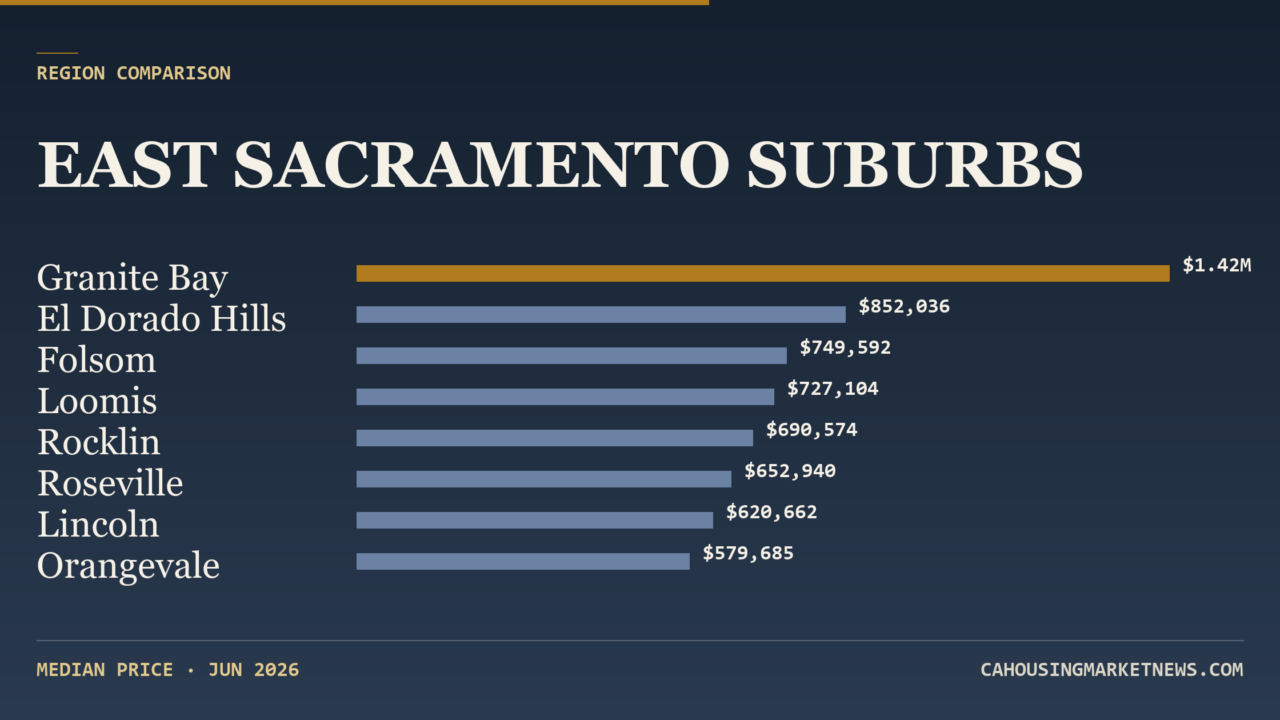
A clear split has opened across the region’s housing market this spring. In the three months ending June 2026, five of the eight cities tracked by Redfin posted year-over-year declines in their median sale price, while three saw prices rise — and the sharpest movements landed at opposite ends of the price spectrum. El Dorado Hills recorded the steepest drop, with its median falling 10.3% from a year earlier, while Loomis logged the largest gain at 20.2%. Yet nearly every city sold more homes than it did a year ago, a sign that transaction volume strengthened even where prices softened.
Prices: El Dorado Hills falls hardest, Loomis and Granite Bay climb
According to Redfin data for the three months ending June 2026, El Dorado Hills posted the region’s largest price decline, with its median sale price falling to $852,036, down 10.3% from $950,000 a year earlier — a drop of roughly $98,000. That decline stands out against the more modest movements elsewhere.
Folsom and Lincoln both saw their medians fall 4.5% year over year. Folsom’s median reached $749,592, down from $785,000, while Lincoln’s fell to $620,662 from $650,000. Rocklin edged down 1.4% to $690,574 from $700,000, and Orangevale slipped 0.8% to $579,685 from $584,500 — the smallest change among the declining cities.
On the other side of the ledger, Loomis posted the region’s largest increase, with its median rising 20.2% to $727,104 from $605,000 a year earlier. That figure warrants caution: Loomis recorded just 25 sales in the period, and small sales pools can produce outsized percentage swings that do not reflect a broad market shift. Granite Bay, the region’s most expensive city, saw its median climb 4.9% to $1,415,979 from $1,350,000. Roseville rounded out the gainers with a 2.0% increase to $652,940 from $640,000.
By price level, Granite Bay remains the region’s most expensive market by a wide margin at just over $1.4 million — nearly $564,000 above the next-highest city, El Dorado Hills at $852,036. Lincoln is the most affordable at $620,662, followed closely by Orangevale at $579,685, which is the lowest median in the group.
Sales activity: volume rose almost everywhere
While prices diverged, sales activity moved in a more consistent direction. Seven of the eight cities sold more homes than they did a year earlier, according to Redfin.
The largest volume gains came in Orangevale and Folsom. Orangevale sales rose 25.0% to 105 homes from 84, and Folsom sales climbed 24.9% to 266 from 213. Rocklin was close behind, up 21.4% to 216 from 178. El Dorado Hills sold 242 homes, up 15.2% from 210 — a notable increase given that it also recorded the region’s steepest price decline, suggesting lower prices coincided with more transactions there.
More moderate gains appeared in Lincoln, up 9.6% to 296 from 270; Roseville, up 9.4% to 549 from 502; and Loomis, up 4.2% to 25 from 24. Roseville remained the region’s highest-volume market at 549 homes sold.
Granite Bay was the lone exception. Its sales fell 3.8% to 76 from 79 a year earlier, the only year-over-year decline in transaction volume across the eight cities.
Days on market: a mixed picture
The pace of sales moved in different directions depending on the city, and readers should note that a higher number of days on market means homes are selling more slowly.
Several cities sold homes faster than a year earlier. Rocklin’s median days on market fell to 17 from 21, the largest improvement in speed, followed by Loomis at 12 days from 14, Roseville at 20 days from 22, and Lincoln at 20 days from 21.
Others slowed. Granite Bay saw the most pronounced change, with its median days on market rising to 24 from 15 a year earlier — a nine-day increase that made it the slowest-selling market in the region, tied at the higher end with El Dorado Hills. El Dorado Hills itself slowed to 22 days from 19, Folsom to 14 from 12, and Orangevale to 14 from 13.
Loomis, at 12 days, was the fastest-selling market in the region, though its small sales count again limits how much weight that figure can carry. Among higher-volume markets, Folsom and Orangevale, both at 14 days, moved fastest.
Competition: Loomis and Orangevale lead on bidding intensity
Measures of buyer competition point to Loomis and Orangevale as the most competitive markets by some metrics. In Loomis, 50.1% of homes sold above their list price, and the median sale-to-list ratio reached 101.0% — the highest in the region on both counts. Orangevale followed, with 45.7% of homes selling above list and a sale-to-list ratio of 100.1%.
By contrast, the region’s most expensive markets showed the least bidding pressure. In Granite Bay, 29.8% of homes sold above list, the lowest share in the group, with a sale-to-list ratio of 99.6%. El Dorado Hills was similar, with 32.7% selling above list and a ratio of 99.3%, the lowest of the eight cities.
The mid-priced markets clustered in between. Roseville’s sale-to-list ratio was an even 100.0%, with 37.2% of homes selling above list. Folsom and Rocklin both posted ratios of 99.8%, with 37.8% and 36.1% of homes selling above list, respectively. Lincoln’s ratio was 100.1%, with 36.4% selling above list.
Active inventory, as reported by Redfin, was heaviest in Roseville at 994 homes, followed by Lincoln at 589 and El Dorado Hills at 514. The thinnest inventory appeared in Loomis at 43 homes and Granite Bay at 164 — consistent with their smaller overall market size. Roseville also led in new listings at 727, well ahead of Lincoln at 387 and El Dorado Hills at 341.
Rents: El Dorado Hills most expensive, Lincoln cheapest
Rental costs varied widely across the region, according to Zillow data as of June 30, 2026. El Dorado Hills carried the highest median rent at $3,156 per month, roughly $1,800 more than the lowest, Lincoln, at $1,345 per month. Between those two extremes, Folsom stood at $2,655, Roseville at $2,645, Rocklin at $2,469, Orangevale at $2,063, and Loomis at $1,925. (Zillow did not provide a year-ago rent figure for Loomis, so no year-over-year comparison is available for that city.)
Rents rose in every city with comparable year-ago data. The largest increase came in Orangevale, where the median rent climbed 4.2% to $2,063 from $1,980. Folsom followed at 3.1%, rising to $2,655 from $2,576, and El Dorado Hills at 3.0%, rising to $3,156 from $3,063. Rocklin rose 2.3% to $2,469 from $2,414, Lincoln rose 2.2% to $1,345 from $1,316, and Roseville posted the smallest gain at 1.6%, rising to $2,645 from $2,602.
The relationship between rents and home prices differs meaningfully by city. In Lincoln, the region’s second-most-affordable purchase market at a $620,662 median, rents are the lowest in the group at $1,345 — the widest apparent gap between a relatively accessible sale price and a low monthly rent. El Dorado Hills sits at the opposite end: its $852,036 median sale price is the second-highest in the region, and its rent is the highest at $3,156, so households there face the steepest costs on both sides.
Granite Bay, the most expensive city to buy at more than $1.4 million, had no rental figure in the Zillow data, reflecting a market where ownership dominates. Loomis presents an unusual pairing — a $727,104 median sale price alongside a comparatively modest $1,925 median rent — though its small size means both figures rest on limited transactions. In the region’s higher-volume mid-tier, Folsom and Roseville carry nearly identical rents just above $2,600 despite Folsom’s roughly $97,000 higher median sale price, suggesting renting is relatively more favorable versus buying in Folsom than in Roseville on these figures.
National backdrop
The regional data arrives against a national interest-rate environment that has eased over the past year. The 30-year fixed mortgage rate averaged 6.49% in June 2026, up slightly from 6.44% in May but down from 6.82% in June 2025, according to Freddie Mac data reported through the Federal Reserve. The 15-year fixed rate averaged 5.82% in June, compared with 5.95% a year earlier.
Nationally, home prices continued to rise year over year, with the S&P/Case-Shiller U.S. National Home Price Index higher than its level a year earlier — a contrast with the price declines recorded in most of the region’s cities this period. That divergence underscores how local conditions, including inventory levels and the mix of homes sold, can pull a market in a different direction from the national trend.
The bottom line
For buyers weighing where to shop, the three months ending June 2026 offered lower prices in five of eight cities, led by El Dorado Hills, alongside broadly stronger sales volume. Competition remained most intense in the smaller and more affordable markets of Loomis and Orangevale, while the high-priced markets of Granite Bay and El Dorado Hills gave buyers the most negotiating room, with the largest shares of homes selling at or below list. Renters, meanwhile, faced higher costs across every city with comparable data, with the sharpest increases in Orangevale and the widest spread separating El Dorado Hills at the top from Lincoln at the bottom.