Sales activity climbed sharply across most of the region even as median prices moved in mixed directions, according to Redfin data for the three months ending July 2026. Three of the four cities tracked — Woodland, Davis and West Sacramento — recorded double-digit gains in homes sold compared with a year earlier, and homes changed hands faster in every market that grew. The exception was Winters, where a small pool of transactions produced the region’s steepest price decline and its only drop in sales.
Prices: Woodland the only city to rise
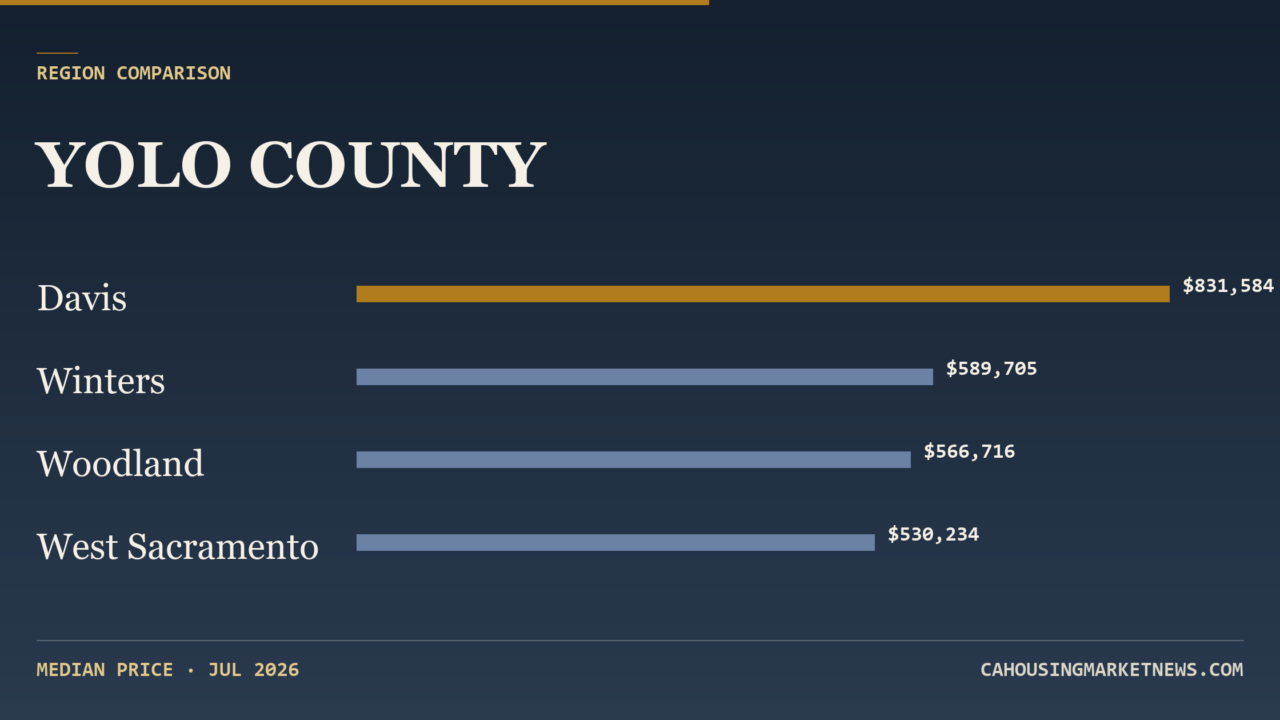
Woodland was the sole market to post a year-over-year price gain, with its median sale price reaching $566,716, up 1.2% from $560,000 a year earlier. Every other city declined. Davis, the region’s most expensive market at a median of $831,584, fell 3.3% from $860,000 a year ago. West Sacramento, the cheapest of the four at $530,234, slipped 1.4% from $537,500. Winters posted the largest decline, with its median falling 4.3% to $589,705 from $616,000. That said, Winters recorded just 15 sales in the period, and small sample sizes can produce outsized percentage swings, so its figures warrant caution.
The regional price spread remains wide. Davis commands roughly $300,000 more than West Sacramento at the median, with Woodland and Winters occupying the middle tier near $567,000 and $590,000 respectively.
For national context, the S&P/Case-Shiller U.S. National Home Price Index rose year-over-year in its latest reading, a direction that contrasts with the price softening seen in three of the four local markets.
Sales and speed: buyers moved quickly
Transaction volume was the region’s clearest trend. West Sacramento led with 106 homes sold, up 34.2% from 79 a year earlier. Woodland followed closely, with sales up 33.3% to 140 from 105. Davis rose 16.5% to 141 sales from 121. Winters ran counter to the region, with sales falling 28.6% to 15 from 21.
Homes also sold faster in the three growing markets. Woodland’s median days on market fell to 19 from 27 a year ago, the fastest pace in the region. Davis dropped to 20 days from 27, and Winters shortened to 20 days from 39 a year earlier — its largest year-over-year change on this metric, though again drawn from a thin sales pool. West Sacramento was the outlier: its median days on market edged up to 22 from 21 a year ago, making it the region’s slowest-selling market this period.
Competition varied. Winters had the highest share of homes selling above list price at 46.7%, followed by Woodland at 34.4%, West Sacramento at 30.8% and Davis at 29.8%. On the sale-to-list ratio, Davis reached 100.0% and Winters 99.8%, both edging out Woodland at 99.6% and West Sacramento at 98.8%.
Inventory: supply concentrated in the larger markets
Davis carried the most active inventory at 256 homes, followed by Woodland at 223 and West Sacramento at 198. Winters, the smallest market, listed 40 active homes. New listings followed the same order: Davis added 160, Woodland 150, West Sacramento 128 and Winters 31. The combination of rising sales and faster selling times in Woodland and Davis suggests demand kept pace with the homes coming to market in those cities.
Rents: Davis most expensive, Woodland flattest
Davis is the most expensive city to rent as well as to buy, with a median rent of $2,702 per month as of July 31, according to Zillow. That figure rose 3.1% from $2,622 a year earlier — the largest rent increase of the four cities. West Sacramento posted the second-largest rent gain, up 2.2% to $2,253 from $2,204, and it remains the region’s most affordable place to rent. Woodland sat in the middle at $2,462, up just 0.3% from $2,454 a year ago, the smallest rent change in the region and effectively flat. Rental data for Winters was not available for this period.
The rent-versus-buy picture differs by city. In Davis, the region’s priciest market on both counts, high home prices are paired with the highest rents, and both are rising on the rental side even as sale prices fell 3.3% year-over-year. West Sacramento offers the lowest entry point on both measures, with the region’s cheapest median sale price and cheapest median rent. Woodland stands out for stability: it is the only city where sale prices rose over the year, yet its rents were essentially unchanged, meaning renters there saw little movement while buyers faced modestly higher prices. That divergence between a 1.2% price gain and a 0.3% rent change makes Woodland the clearest case in the region where the ownership and rental markets moved on different tracks.
Borrowing costs: national rates lower than a year ago
Mortgage rates provide backdrop for the region’s activity. The 30-year fixed rate averaged 6.54% in July 2026, up slightly from 6.49% in June but below the 6.72% average of July 2025, according to Freddie Mac via the Federal Reserve. The 15-year fixed rate averaged 5.91% in July, up from 5.82% in June and roughly in line with the 5.86% recorded a year earlier. These are national averages and are not specific to the region’s four cities.
The bottom line for buyers and renters
For the three months ending July 2026, the region’s story was one of quicker sales against a backdrop of mostly softer prices. Woodland was the most active on multiple fronts — the fastest-selling market, one of the two largest sales gains, and the only city with rising prices — while keeping rents flat. West Sacramento remained the most affordable market to both buy and rent, though it was also the slowest to sell. Davis held its position as the region’s high-cost market on both prices and rents. Winters, with just 15 sales, saw the region’s largest price decline and its only drop in transactions, figures that should be read in light of its small size.