The clearest divide across the region this summer is not between fast and slow markets, but between price tiers moving in opposite directions. In El Dorado Hills, the median sale price fell 11.2% from a year earlier, the steepest decline among the eight cities tracked, according to Redfin data for the three months ending July 2026. At the same time, Orangevale and Roseville posted modest gains, and tiny Loomis recorded a 25.5% jump on a handful of sales. The result is a region where sales activity is broadly rising even as prices split sharply by city and by segment.
Prices: El Dorado Hills falls hardest, Loomis swings on thin volume
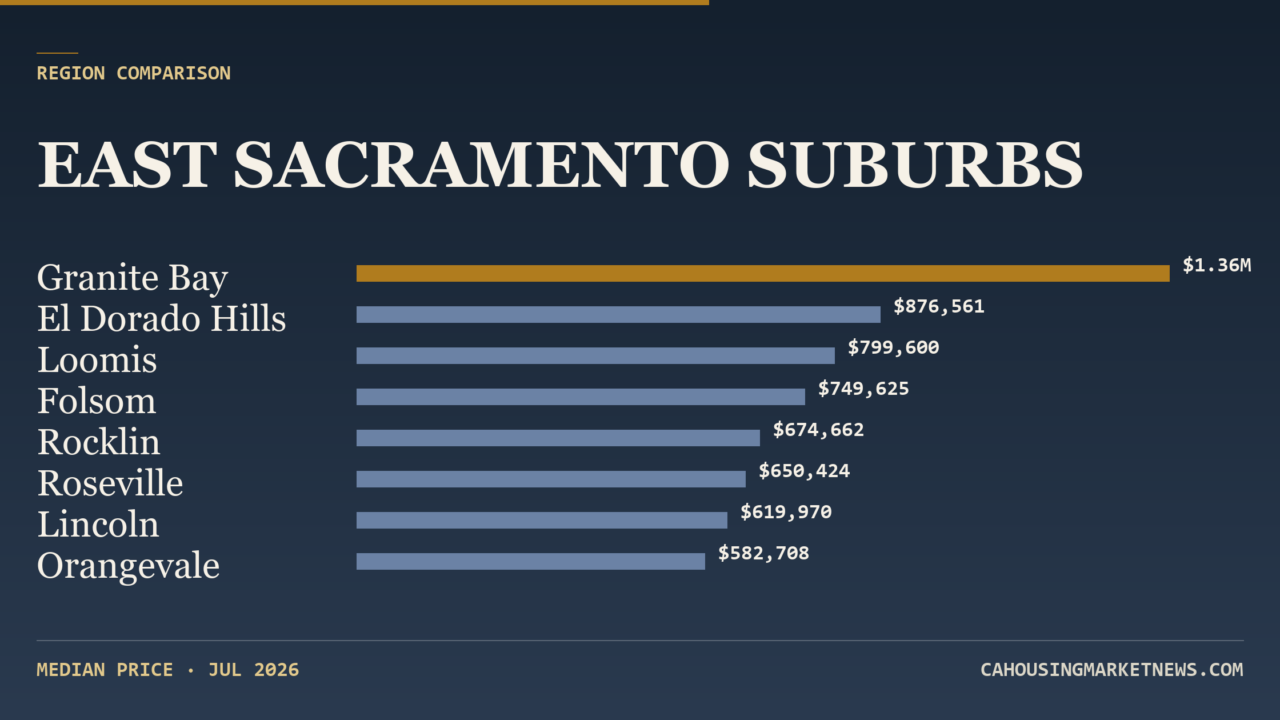
El Dorado Hills led the region’s declines with a median sale price of $876,561, down 11.2% from $987,000 a year earlier. Folsom followed with a 6.3% drop to $749,625, from $800,000, and Lincoln fell 5.1% to $619,970, from $653,000. Rocklin declined 3.6% to $674,662, from $700,000, and Granite Bay edged down 0.8% to $1,359,319, from $1,370,000.
On the other side of the ledger, Loomis reported a median of $799,600, up 25.5% from $637,000 a year ago. That figure warrants caution: Loomis recorded just 24 sales in the period, down from 27 a year earlier, and small sample sizes can produce outsized percentage swings that do not necessarily reflect a broad shift in underlying values. Orangevale rose 3.1% to $582,708, from $565,000, and Roseville added 1.5% to $650,424, from $640,606.
Granite Bay remains the region’s most expensive market by a wide margin, with a median of $1,359,319 — roughly $483,000 above the next-priciest city, El Dorado Hills. Orangevale is the most affordable to buy at $582,708, followed by Lincoln at $619,970 and Roseville at $650,424.
Nationally, home prices continued to rise: the S&P/Case-Shiller U.S. National Home Price Index was higher in June 2026 than a year earlier, according to Federal Reserve data. That contrasts with the year-over-year price declines seen in five of the eight cities here, underscoring that several of the region’s markets softened even as national prices held their upward direction.
Sales activity: volume rises almost everywhere
Home sales climbed in six of the eight cities year over year, a consistent theme across price tiers. Orangevale saw the largest increase, with 102 homes sold versus 74 a year earlier, a gain of 37.8%. Roseville followed with 579 sales, up 19.1% from 486, and Folsom rose 16.0% to 254 sales, from 219. El Dorado Hills gained 14.9% to 246 sales, from 214, and Rocklin rose 12.6% to 214, from 190. Lincoln added 10.2%, reaching 293 sales from 266.
Two cities bucked the trend. Loomis sold 24 homes, down 11.1% from 27, and Granite Bay sold 83, down 3.5% from 86. Both are lower-volume markets where small changes in the number of transactions translate into larger percentage moves.
Roseville was the region’s busiest market by transaction count, with 579 sales, followed by Lincoln at 293 and Folsom at 254. Loomis and Granite Bay, at 24 and 83 sales respectively, were the smallest.
Speed and competition: Loomis and Orangevale move fastest
Homes sold fastest in Loomis, where the median days on market was 8, down from 15 a year earlier. Orangevale followed at 14 days, an improvement from 21 a year ago. At the slower end, El Dorado Hills homes took a median of 26 days to sell, up from 24 a year earlier — the region’s longest, and one of the few cities where the pace lengthened rather than shortened.
Most other cities were tightly clustered. Folsom sold in a median of 20 days, up slightly from 19; Rocklin held at 21 days, unchanged from a year ago; Granite Bay also held at 21, unchanged; Roseville improved to 22 days from 24; and Lincoln shortened to 24 days from 26.
Competition, measured by the share of homes selling above list price, was strongest in the region’s smaller markets. In Loomis, 47.9% of homes sold above asking, and its sale-to-list ratio of 100.7% was the highest in the region. Orangevale was close behind, with 42.0% selling above list and a sale-to-list ratio of 100.3%. Both were the only two cities where the typical home sold for more than its asking price.
At the other end, Granite Bay was the least competitive on this measure, with 27.2% of homes selling above list and a sale-to-list ratio of 99.0%. El Dorado Hills was similar, at 27.5% above list and a 99.2% ratio. The larger, higher-volume markets fell in between: Roseville at 34.1% above list and 99.7%, Folsom at 33.9% and 99.6%, Rocklin at 31.6% and 99.3%, and Lincoln at 30.1% and 99.8%.
Inventory: supply concentrated in the larger markets
Active inventory was heaviest in the region’s largest markets. Roseville led with 1,019 active listings and 695 new listings during the period, followed by Lincoln with 592 active and 367 new, and El Dorado Hills with 527 active and 314 new. Folsom held 475 active listings against 316 new, and Rocklin 437 active against 288 new.
The smaller markets carried far less supply. Loomis had just 38 active listings and 24 new, Granite Bay 171 active and 104 new, and Orangevale 188 active and 128 new. That thin supply in Loomis and Orangevale aligns with their faster sale times and higher above-list shares, while the deeper inventory in El Dorado Hills coincides with the region’s longest days on market and steepest price decline.
Rents: Granite Bay the priciest, Lincoln the cheapest
Rental costs varied widely across the region, according to Zillow data as of July 31, 2026. Granite Bay had the highest median rent at $3,711 per month, followed by El Dorado Hills at $3,157. At the low end, Lincoln’s median rent of $1,330 was by far the cheapest — less than half the rent in El Dorado Hills and roughly a third of Granite Bay’s. Orangevale ranked next-lowest at $2,149.
The remaining cities clustered in the middle: Folsom at $2,670, Roseville at $2,579, and Rocklin at $2,497. Rental data was not available for Loomis in this period.
Year-over-year rent changes were modest across most of the region. Orangevale posted the largest increase, with rents up 5.4% to $2,149 from $2,039 a year earlier. El Dorado Hills rents rose 3.6% to $3,157, from $3,047; Folsom rose 3.4% to $2,670, from $2,583; and Rocklin rose 3.1% to $2,497, from $2,423. Lincoln rents increased 1.9% to $1,330, from $1,306, and Roseville was essentially flat, up 0.4% to $2,579, from $2,570. (Year-ago rent figures were not provided for Granite Bay.)
The rent-versus-buy picture differs sharply by city. Lincoln stands out: its rents are the region’s lowest at $1,330 per month, yet its median sale price of $619,970 sits in the middle of the pack. That combination — low rents against a mid-tier purchase price — makes renting comparatively attractive there relative to the cost of buying. Orangevale presents a different balance, pairing the region’s most affordable home price ($582,708) with a mid-range rent of $2,149, alongside the fastest-rising rents and one of the most competitive purchase markets.
In the higher-priced cities, both renting and buying carry premiums. Granite Bay leads on both fronts, with the region’s highest home price and highest rent. El Dorado Hills has the second-highest rent at $3,157, but its median home price fell 11.2% over the year — a shift that has narrowed the gap between its sale prices and those of lower-tier cities even as its rents continued to rise.
Rate backdrop
Mortgage rates provide national context for the period. The 30-year fixed rate averaged 6.54% in July 2026, up from 6.49% in June 2026 but down from 6.72% in July 2025, according to Freddie Mac data via the Federal Reserve. The 15-year fixed rate averaged 5.91% in July 2026, compared with 5.82% in June 2026 and 5.86% in July 2025. These are national averages and do not reflect any single borrower’s terms or local conditions.
Taken together, the region’s data show broadly rising sales volume paired with a clear split in prices: declines concentrated in the higher-priced markets of El Dorado Hills, Folsom, and Rocklin, and gains in the more affordable and lower-volume markets of Orangevale, Roseville, and Loomis. Buyers and renters weighing the region face meaningfully different trade-offs from one city to the next — from Lincoln’s low rents to Granite Bay’s premiums on both sides of the market.